Abstract: The initial draft of this paper was written in response to a request
for research on the relationship between self-direction in the workplace, employee ownership,
and organizational outcomes. It outlines three aspects of shared decision-making: autonomy,
participation, and influence. It then explores the relationship between two of those aspects
(autonomy and participation) and a series of productivity-related cultural norms, including
ownership identity.
As we understand ownership culture, decision making breaks down into three major
categories. Specific companies may embrace all, some or none of these types of shared
decision making, defined below:
Autonomy: individual employees having the space to manage their day-to-day
jobs in the manner they see best. Autonomy is the absence of "micro-management."
Participation: groups of employees contributing to the operation of the
group in which they work, whether that be a department, division, shift or work team. The
type of issues concerned can range from personnel issues to work scheduling to compensation.
Participation can be considered having a role in "local" decision-making.
Influence: the work force as a whole having input over the overall direction
and strategy of the company. Influence can be considered having a role in "global" decisions.
The concept of self-direction is positioned somewhere between the first two of these
aspects of shared decision making: a work force organized into self-directed work teams will
necessarily have a degree of both autonomy and participation-they will not necessarily
participate in setting company strategy. The OCS includes a number of survey items which
explore autonomy and participation. Several items are combined to produce a single measure
of each issue.
Self Direction and Organizational Behavior
In addition to measures of self-direction, the OCS includes a number of other
items which explore cultural norms of relevance in understanding the operational efficiency
of an employee-ownership company, including:
1. People here work hard.
2. Around here employees feel that finding and correcting mistakes is management's responsibility.
3. People here care about meeting customers' needs.
4. People here feel 'my job is not important enough to affect company performance.'
5. When serious operational problems arise in my department, they are often ignored.
6. I have the tools and resources I need to get my job done.
Two caveats are in order. (1) These items measure respondents' perceptions of
each of these organizational outcomes. While these perceptions are undoubtedly an imperfect
measure of actual conditions, they may be presumed to be a reasonable proxy. In
addition, the cultural norms they represent are of importance in their own right. (2) The
OCS database consists of results exclusively from employee-ownership companies-results of
the OCS should be understood to be relevant to other employee-ownership companies, but not
necessarily to companies attempting to build a culture of ownership without actual employee
ownership of company equity.
When we look to the data from companies which have taken the OCS, we find that the
relationship between both autonomy and participation, on the one hand, and these items of
interest, on the other hand, is consistently positive and statistically significant. Based
on our results to date, in other words, companies which successfully foster a feeling of
autonomy and/or participation in local decisions tend to have employees who believe:
- that they work hard,
- that they are responsible for correcting mistakes,
- that meeting customers' needs is important,
- that they have an impact on company performance,
- that their department manages problems, and
- that they have what they need to get their jobs done.
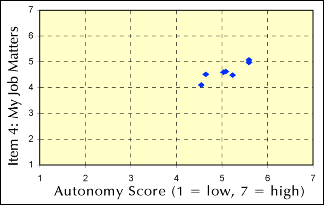
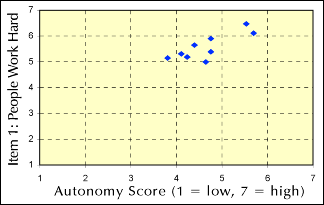
To illustrate some of these tendencies, observe the following scatter plots, in which each
point represents a company which has taken the OCS. Each indicates the general tendency that
companies with higher scores on autonomy or participation tend to have higher scores on the
variables of interest as well.
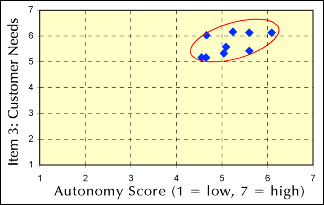
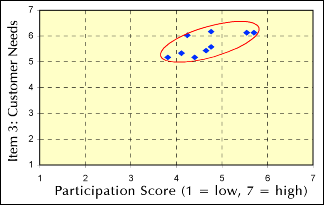
Compare the following two charts, both of which look at item 3 ("People here care about
meeting customers' needs"). The relationship between autonomy and item 3 is somewhat
weaker than the relationship between participation and item 3, as you may observe by the
"flatter" oval which captures all the points in the participation chart.
This observation generalizes into the first of two hypotheses we will advance in this memo:
Hypothesis 1: Participation is more closely related to the desired outcomes (items 1
through 6) than is Autonomy.
The remainder of the correlations and scatter charts (not pictured here) also support
this hypothesis. We should emphasize that this does not imply that autonomy is
less important than participation. It does suggest that participation is more important with
regard to the six outcomes discussed above.
Self Direction and Ownership Identity
An area of substantial concern is the relationship between an individual's sense of
ownership (i.e., the extent to which she identifies herself as an owner of the company) and
self-direction. Our data indicates that the relationship in each case is strong, indicating
that employees with a sense of autonomy, of participation, and of influence tend to feel
more like owners. Continuing our emphasis on autonomy and participation, the following
two scatter plots illustrate the relationship.
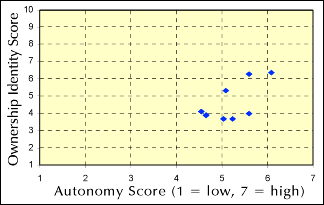
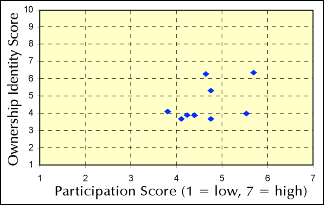
The relationship to Ownership Identity is strong for all three decision making issues, but
note that in this case, the relationship is stronger for Autonomy than it is for Participation.
The difference is not large, and it awaits further clarification as more companies use the
OCS. There is, however strong ground for advancing the following hypothesis:
Hypothesis 2: Employees who exercise decision making authority, whether in the form
of autonomy, participation in local decisions, or influence in company-wide issues, tend to
feel more like owners.
The data suggest, but do not yet justify confidence in, a corollary hypothesis:
Hypothesis 2a: A degree of autonomy and influence in company-wide issues is more
strongly related to ownership identity than is participation in local decisions.
Further information on these hypotheses, and more detail about the relationship
between self direction and a variety of organizational outcomes, including performance
measures, communications systems, and widespread entrepreneurial outlook, will be
forthcoming in a future issue of the Ownership Culture Reports. [See, for example,
Vol. 1, No. 2: Participation:
Decision Making and Employee Ownership.] The Ownership
Culture Reports are a free series of working papers published by Ownership Associates
as a service to the employee-ownership community. For more information about this memo or
to add yourself to our distribution list, contact Ownership Associates.

